How thick should a concrete driveway be in Arizona?
Four inches is the standard for a residential driveway that carries cars and SUVs, poured over a compacted gravel base. Park trucks, trailers, or an RV on it and the right build is 5 to 6 inches with rebar. In Arizona, what is under the slab matters as much as the thickness.
That 4-inch figure is not a guess. It is the residential benchmark backed by Portland Cement Association and American Concrete Institute guidance, and building codes generally set their minimum at three and a half to four inches. Here is how thickness, reinforcement, base prep, and joints fit together on a concrete driveway that has to live in East Valley ground.
Thickness by what parks on it
| What the slab carries | Thickness | Reinforcement | Mix |
|---|---|---|---|
| Cars, SUVs, minivans | 4 inches | Wire mesh (common practice) | 3,000–3,500 PSI |
| Occasional work truck or trailer | 5 inches | Rebar | 3,500 PSI |
| RVs, boats, heavy trucks | 6 inches | Rebar grid | 3,500–4,000 PSI |
A passenger car weighs 3,000 to 6,000 pounds and a 4-inch slab shrugs that off for decades. The math changes above roughly 12,000 pounds, which is why an RV parked on a car-spec driveway eventually leaves its signature in cracks. If a rig lives at your place, that pad deserves the heavier build, and it is exactly what our RV pads and parking slabs are poured to handle.
Why the base decides how long the driveway lasts
Concrete is strong in compression and weak in bending. When the ground under a slab moves or washes out, the slab bends, and that is when it breaks. So the base does more for longevity than an extra inch of concrete ever will.
Common practice is 4 to 6 inches of well-graded gravel, compacted hard, with more depth over poor soil. East Valley ground makes this non-negotiable. Much of the area sits on expansive clay that swells when monsoon moisture arrives and shrinks when it leaves, and on caliche, a cemented hardpan that stops water from draining and turns excavation into real work. We covered what those soils do to slabs in why concrete cracks in Arizona. The short version: prep the ground properly and the thickness chart above works. Skip it and no thickness chart can help.
Rebar, wire mesh, or fiber
The honest framing first, straight from industry guidance: reinforcement does not prevent cracks. It holds them together so they stay hairline instead of opening up and shifting.
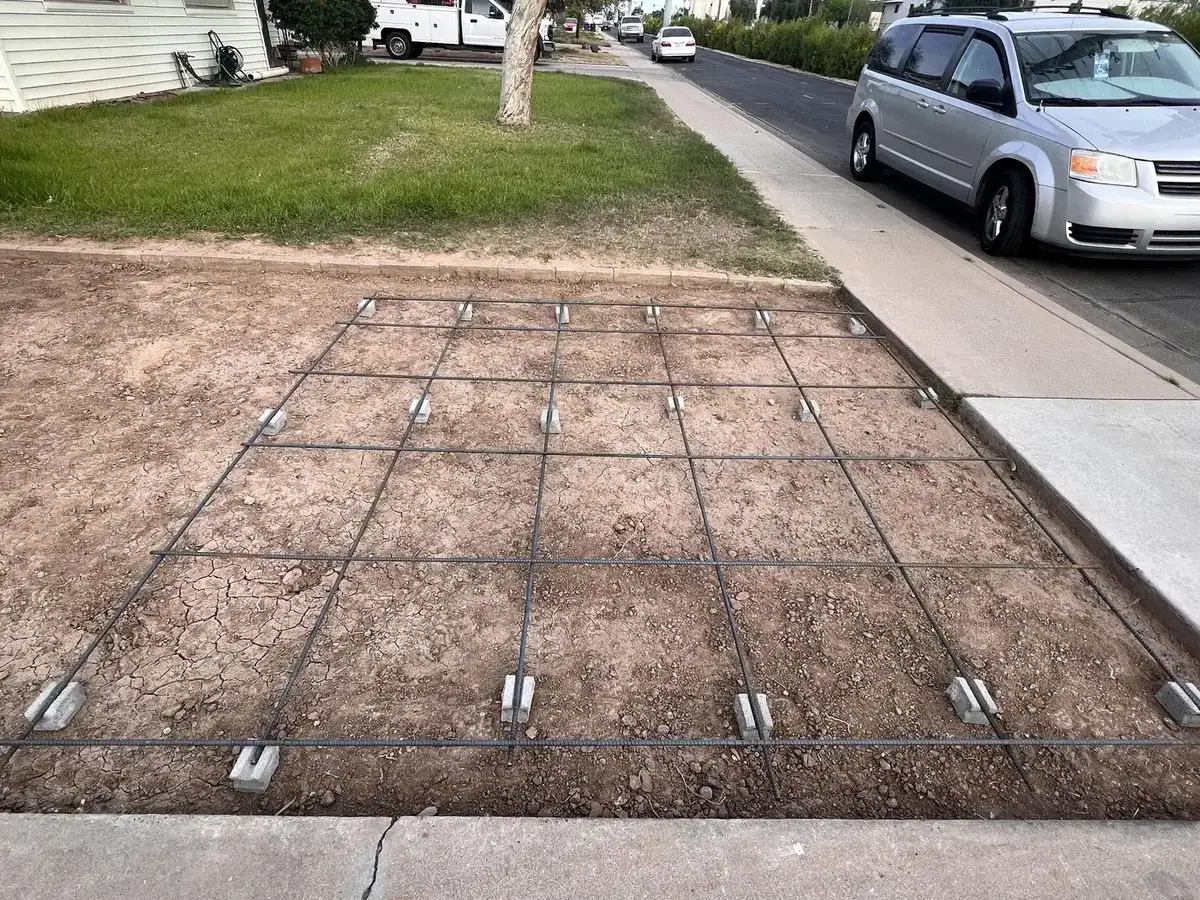
Wire mesh is the common choice inside 4 to 5 inch slabs. Rebar, usually in a grid, belongs in slabs 5 inches and up and anywhere heavy loads park. Fiber mixed into the concrete helps with surface shrinkage cracking while the slab cures, and it is a nice supplement, but it does not do the structural job of steel. For a driveway that will ever see a loaded truck, rebar is cheap insurance against a slab you would otherwise replace.
Control joints, the crack management plan
Concrete shrinks as it cures, so it is going to crack somewhere. Control joints tell it where. The rule of thumb from concrete engineering guidance: joint spacing in feet at two to three times the slab thickness in inches, cut to about a quarter of the slab’s depth. For a 4-inch driveway that means joints every 8 to 12 feet, about an inch deep.
Treat those numbers as rules of thumb rather than code requirements, because panel layout also matters. Long skinny panels and sharp inside corners invite random cracking, so a good layout keeps panels close to square. Cutting has a clock on it too, and Arizona’s heat shortens it: joints go in as soon as the slab can take a saw without raveling, which in summer can mean the same day as the pour.
What Arizona heat changes about the pour
Thickness specs are national. Our pour conditions are not. Fresh concrete in 110 degree heat wants to flash-dry, which weakens the surface and invites plastic shrinkage cracking, so summer pours get scheduled for early morning, the mix gets adjusted, and curing gets real attention instead of an afterthought. None of that changes how thick the slab should be. It changes whether the slab reaches the strength the thickness chart assumes.
If you are pricing the whole project rather than speccing it, our guide to concrete driveway costs in Arizona has the market numbers, and concrete versus asphalt in the Arizona heat covers the other big driveway decision.
FAQ
What is the 4 2 1 rule for concrete? A rough mix proportion, four parts aggregate, two parts sand, one part cement. Ready-mix plants batch to engineered strength instead, so you order by PSI and the plant handles proportions.
Do you need gravel under a concrete driveway? Yes. A compacted gravel base, commonly 4 to 6 inches, gives uniform support and drainage. On East Valley clay and caliche it is the difference between a slab that lasts and one that cracks early.
Is thicker concrete less likely to crack? Thickness helps, but the base decides. A 4-inch slab on properly compacted ground outlasts a 6-inch slab on dirt. Thickness, steel, joints, and base prep work as a system.
How much does a 20x20 pad cost? Around $2,400 to $6,000 installed at Arizona market rates, with finish driving the spread. Heavy-vehicle builds add cost per foot. Market ranges, not a quote.
Rebar or wire mesh? Mesh for 4 to 5 inch slabs, rebar for 5 and up or heavy loads, fiber as a supplement. Steel does not prevent cracks, it keeps them tight.
What PSI should the mix be? 3,000 to 4,000 PSI. 3,000 covers cars, and 3,500 to 4,000 buys durability for trucks and hard exposure. The upcharge is small.
Build it to the right spec
The cheapest driveway is the one you pour once. DC Construction and Development builds concrete driveways across Queen Creek and the East Valley to the spec the load actually needs, base prep included, and we will tell you plainly when 4 inches is enough and when it is not. Ask for a free estimate and we will spec it for how you actually use it.